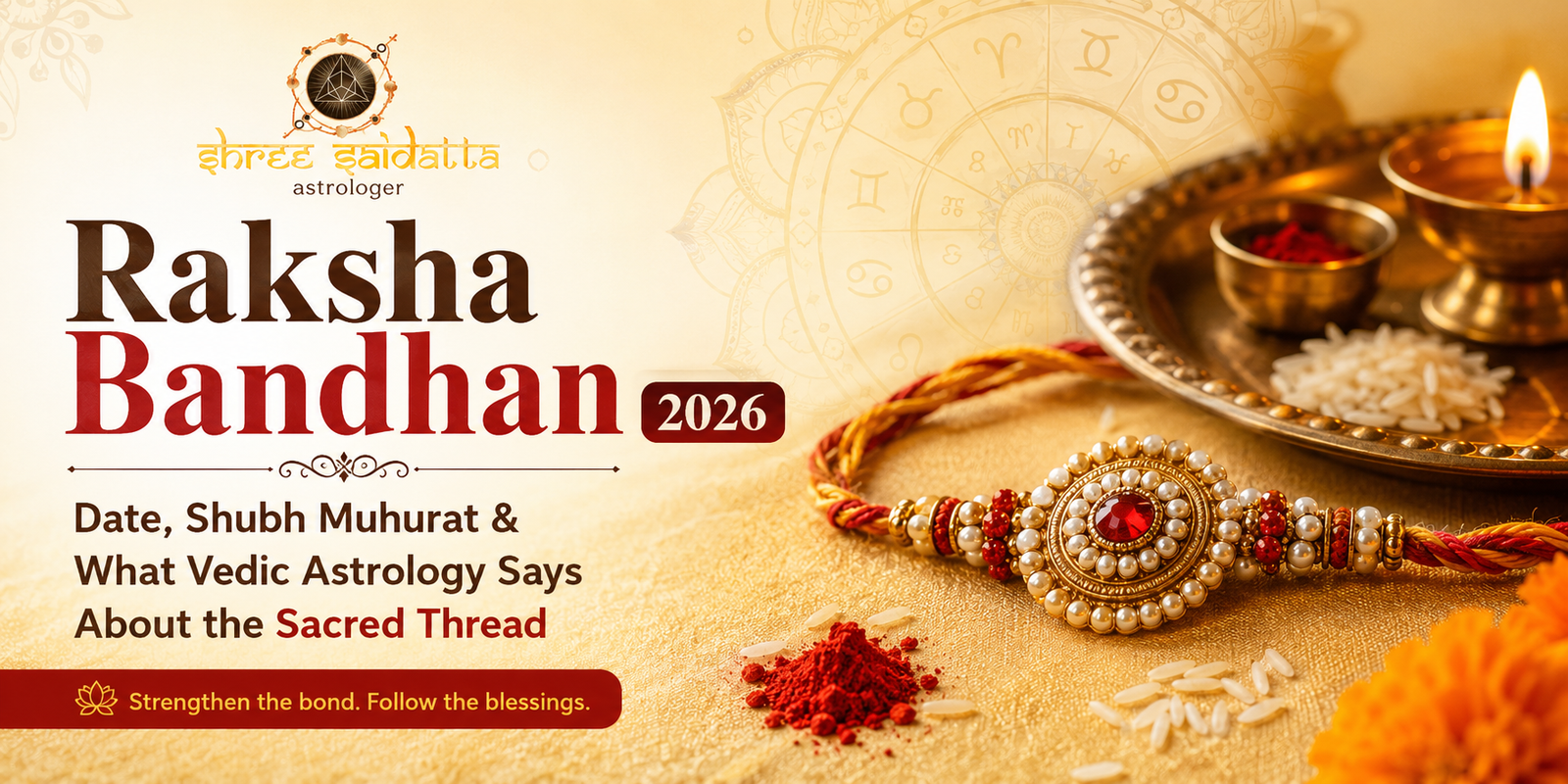
Every year, as Shravan month arrives and the monsoon settles over, homes start filling up with a familiar excitement. Sisters go shopping for the perfect rakhi, brothers wait (half-teasingly) to see what gift comes their way, and somewhere in between the sweets and the selfies, a much older ritual quietly repeats itself — one that Vedic astrology has always taken rather seriously.
Raksha Bandhan is not just a festival of thread and affection. In Hindu astrology, the day carries real planetary weight, and the timing of the rakhi ceremony is treated as more than a formality. If you have ever wondered why your family insists on tying rakhi before a certain hour, or why elders keep mentioning “Bhadra,” this blog will walk you through both — the correct Raksha Bandhan date, the shubh muhurat for 2026, and the deeper astrological reasoning behind it.
This year’s celebration also falls within Shravan month, a period already packed with festivals and fasting traditions — if you’re tracking the full month’s calendar, our Sawan 2026 guide covers every important date and vrat alongside Raksha Bandhan.
When Is Raksha Bandhan in 2026?
Raksha Bandhan 2026 falls on Friday, 28th August 2026, coinciding with Shravana Purnima — the full moon day of the Shravan month in the Hindu lunisolar calendar. Here is the exact Rakhi muhurat and Raksha Bandhan shubh muhurat for this year, based on the Pune panchang.
Key Panchang details for 2026:
- Purnima Tithi begins: 9:08 AM, 27th August 2026
- Purnima Tithi ends: 9:48 AM, 28th August 2026
- Shubh Muhurat for tying Rakhi: 5:57 AM to 9:48 AM
- Bhadra Kaal: Ends before sunrise — no conflict this year
- Rahu Kaal (to avoid): 10:46 AM to 12:22 PM
This is genuinely good news for families this year. In many years, Bhadra Kaal eats into a large part of the morning, forcing households to wait until afternoon. In 2026, since Bhadra concludes before sunrise itself, the entire morning window is clean and auspicious — you can perform the ceremony any time between 5:57 AM and 9:48 AM without worrying about inauspicious timing.
If the morning gets missed for any reason, Aparahna (early afternoon, roughly after 1:30 PM) is considered the next best Rakhi shubh time — just steer clear of Rahu Kaal between 10:46 AM and 12:22 PM.
Why Timing Actually Matters in Astrology
A common question we hear during consultations at Shree Sai Datta is — does it really matter when you tie the rakhi, as long as it happens on the right day?
In Vedic astrology, the answer is yes. Bhadra Kaal is governed by an energy associated with disruption and discord — traditionally linked to the sister of Shani Dev. Rituals performed during this period are believed to carry the risk of misunderstandings or friction between siblings later in the year, which is exactly the opposite of what Raksha Bandhan is meant to invoke. That’s why priests and astrologers always emphasise checking the muhurat before beginning the ceremony, rather than tying rakhi at whatever time is convenient.
The full moon itself also plays a role. Purnima is associated with heightened emotional energy and the Moon’s influence on relationships, memory, and the mind. Performing an emotionally significant ritual on this day is believed to amplify its effect — which is part of why Raksha Bandhan was placed on Shravana Purnima in the first place, rather than any random date.
The Deeper Meaning Behind the Thread
Long before it became a day of sweets and gift envelopes, Raksha Bandhan carried a far more solemn meaning. The word itself comes from two Sanskrit roots — “Raksha,” meaning protection, and “Bandhan,” meaning a bond or tie. Together, they describe a vow, not just a decoration for the wrist.
In earlier times, a protective thread of this kind wasn’t limited to brothers and sisters at all. It was tied by priests onto the wrists of kings before battle, and by wives onto husbands as a spiritual shield. The idea was always the same — those with strength owe protection to those they love, and the thread is a reminder of that responsibility. Over centuries, this evolved into the festival we now associate primarily with siblings, though the spiritual undertone of protection and duty never really left it.
This is also why many families still treat rakhi as more than a gesture — the sister’s prayer for her brother’s wellbeing, and the brother’s promise in return, are both considered energetically significant, not merely symbolic.
History of Raksha Bandhan: When Was It First Celebrated?
There’s no single date in history that marks the “beginning” of Raksha Bandhan — its roots go back to Puranic times, long before it became a sibling festival. One of the earliest references appears in the Bhavishya Purana, where Devi Sachi, wife of Indra Dev, ties a protective thread around his wrist before he leaves for battle against the Asuras. The Devas were struggling at the time, and on the advice of Guru Brihaspati, Sachi tied this sacred thread on Shravan Purnima as a form of divine protection. Indra went on to win the battle, and this moment is often cited as the earliest seed of what we now know as Rakhi — not a festival between siblings at first, but a spiritual act of safeguarding someone before they faced danger.
Why Is Raksha Bandhan Also Called Baleva?
In parts of Gujarat and Maharashtra, Raksha Bandhan is still referred to as Baleva — a name that traces back to the legend of King Bali from the Bhagavata Purana. As the story goes, Lord Vishnu took the form of Vamana, a dwarf Brahmin, to reclaim the three worlds from the demon king Bali. In just two strides, Vamana covered the earth and the heavens. With nothing left to offer for the third step, Bali humbly surrendered his own head. Moved by this devotion, Vishnu made him ruler of Sutala loka and even agreed to stay by his side as his protector. This worried Goddess Lakshmi, who wanted her husband back — so she tied a sacred thread on Bali’s wrist and, in exchange for that gesture of protection, asked him to release Vishnu from his promise. Bali agreed, and that act of tying the thread on Shravan Purnima is believed to be why the festival carries the name Baleva in some regions even today.
How Does the Sacred Thread of Protection Actually Work?
Beyond royal legends, one of the most heartfelt stories tied to Raksha Bandhan comes from the Mahabharata — the bond between Sri Krishna and Draupadi. During a yagna hosted by King Yudhishthir, Krishna ended up injuring his finger while dealing with Shishupal. Seeing him bleed, Draupadi immediately tore a strip of cloth from her own saree and wrapped it around his wound. Touched by this small, instinctive act of care, Krishna quietly promised that he would protect her whenever she needed him. Years later, when Draupadi was humiliated in the royal court, Krishna kept that promise, shielding her dignity when no one else stepped forward. This story is often used to explain the real spirit behind the rakhi thread — it isn’t the material of the thread that protects, but the sincerity and promise behind it.
What Astrology Suggests for a More Meaningful Raksha Bandhan
If you’re planning your celebration this year, a few simple astrological considerations can make the ritual more effective, not just more punctual:
Face the right direction. Ideally, the brother should face east or north while the rakhi is tied — directions traditionally associated with positive energy flow.
Use the muhurat window. Even a five-minute ceremony within the shubh muhurat is considered more powerful than a longer one performed outside it.
Mind the thali. A simple thali with rakhi, kumkum, akshat (unbroken rice), a diya, and a sweet is enough — elaborate arrangements aren’t necessary for the ritual to carry weight.
Consider your kundali. For siblings going through a rough patch, or for families dealing with prolonged distance or conflict, a personalised look at the birth charts can offer insight into what’s really at play — and simple remedies to ease it. If you’d like this kind of muhurat checked precisely for your family, rather than relying on a general panchang, our horoscope and kundali analysis service covers exact auspicious timing for rituals like this alongside your birth chart reading.
This last point is something we’re asked about often at our Viman Nagar office. Raksha Bandhan is frequently the day families choose to patch things up, and sometimes a short conversation about the underlying planetary influences — Mercury’s placement for communication issues, or Moon’s affliction for emotional distance — helps far more than either sibling expected.
A Festival That Still Means Something
It’s easy to see Raksha Bandhan as just another calendar entry between Independence Day and Ganesh Chaturthi. But strip away the gift-wrapping and the festival still stands on the same idea it always has — that bonds worth keeping need conscious care, not just affection on autopilot.
Whether you follow the muhurat strictly or simply tie the rakhi whenever your brother is free from work, the sentiment matters more than the clock. But if you’d like to do it right — astrologically speaking — the morning of 28th August 2026, before 9:48 AM, is your best window this year.
If you’d like a personalised reading around family relationships, sibling compatibility, or remedies for recurring conflict at home, Pandit Pravin Shastri — recognised as the best astrologer in Pune — has been guiding families through Vedic astrology, numerology, and Vastu for over 25 years at Shree Sai Datta, Viman Nagar. You can book a consultation online, over WhatsApp, or in person.
Happy Raksha Bandhan to you and your family.
Frequently Asked Questions
What is the correct date for Raksha Bandhan in 2026?
Raksha Bandhan 2026 falls on Friday, 28th August, coinciding with Shravana Purnima. The shubh muhurat for tying rakhi is between 5:57 AM and 9:48 AM.
Is Bhadra Kaal a problem for Raksha Bandhan 2026?
No. This year, Bhadra Kaal ends before sunrise on 28th August, so the entire morning window is considered auspicious with no need to wait or adjust timings.
What happens if rakhi is tied during Bhadra Kaal?
Vedic tradition advises against it. Bhadra is associated with disruption and discord, and tying rakhi during this period is believed to invite friction or misunderstandings between siblings rather than strengthen the bond.
Can rakhi be tied on any wrist?
Traditionally, the rakhi is tied on the right wrist, with the brother facing east or north during the ceremony, as these directions are considered favourable for positive energy flow.
Does astrology really affect how the ritual is performed?
Yes, in Vedic astrology, the timing (muhurat), direction faced, and even the Moon’s phase on Purnima are believed to influence how effectively the ritual’s intention — protection and blessings — is carried through. This is why priests and astrologers recommend checking the panchang before beginning the ceremony rather than tying rakhi at a random hour.