Every year, as the monsoon eases and homes across Maharashtra fill with the fragrance of tulsi and fresh flowers, devotees ask the same question: what is the Janmashtami 2026 date, and when exactly should the midnight puja be performed? At Shree Sai Datta, we believe the answer isn’t just a date on a calendar — it’s a moment governed by precise astrological timing, observed for over five thousand years.
This guide gives you the confirmed date for this year, the exact Nishita Kaal muhurat, and the deeper astrological significance behind why this particular night is considered so powerful.
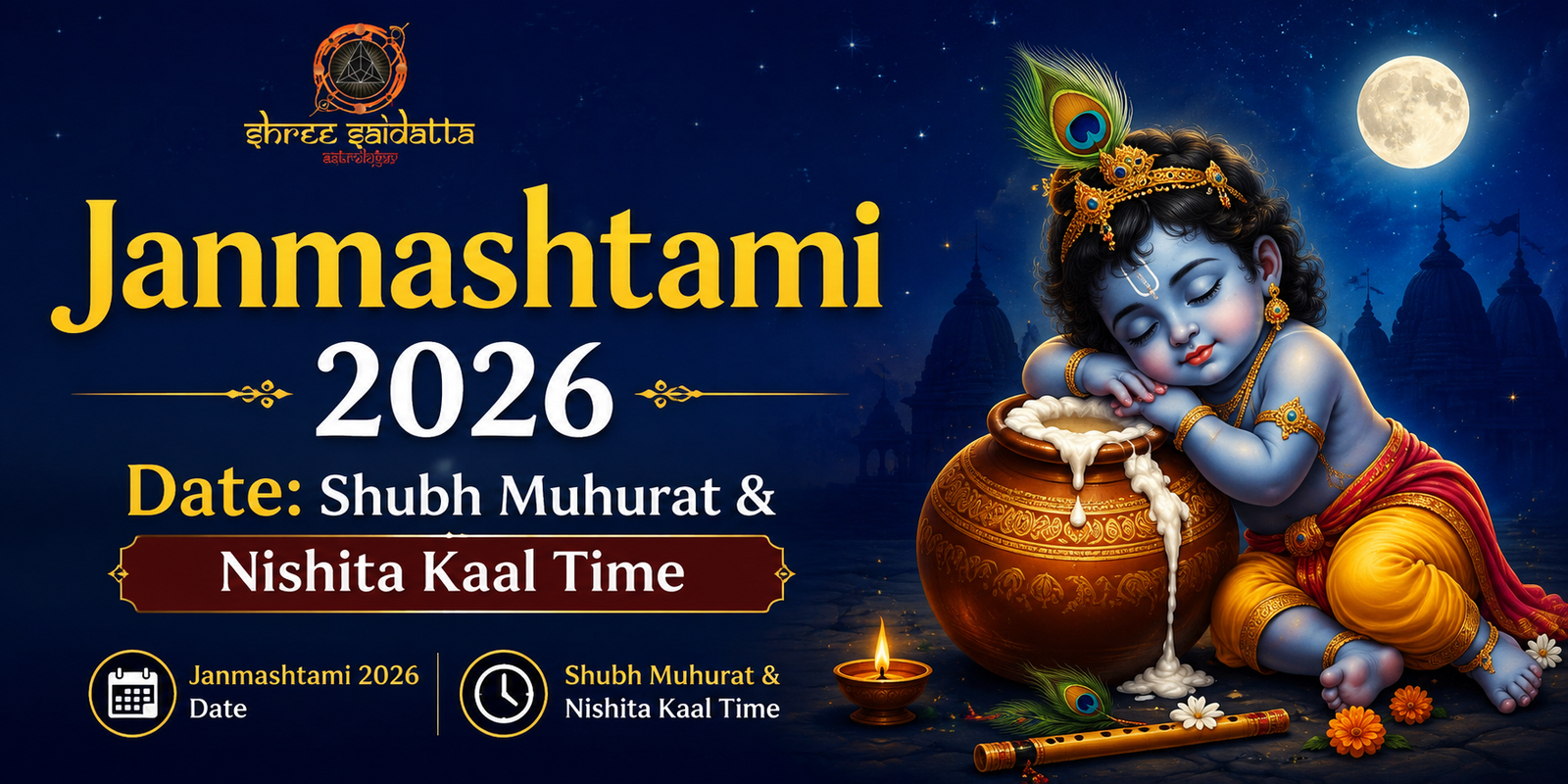
Janmashtami 2026 Date: Friday, September 4
The Janmashtami 2026 date falls on Friday, September 4, according to the Smarta tradition followed by most households across India, including Maharashtra. This is the date on which Ashtami Tithi (the eighth day of Krishna Paksha) is present during Nishita Kaal, the sacred midnight hour.
Devotees who follow the Vaishnava and ISKCON tradition, which gives weight to the union of Ashtami with Rohini Nakshatra at sunrise, observe Krishna Janmashtami on Saturday, September 5. Both dates are correct within their respective traditions — there is no single “wrong” answer here, only a difference in which classical rule your family or sampradaya follows. If your household has no fixed custom, September 4 is the widely accepted default.
Maharashtra follows the amanta calendar, which counts each month from one new moon to the next. Under this system, this Krishna Paksha Ashtami lands inside Shravan, so it’s called Shravan Vadya Ashtami here. North India uses the purnimanta calendar instead, where the same day falls in Bhadrapada — so it’s really just two names for the exact same date.
Interestingly, this timing means the festival arrives just as the Sawan season draws to a close in the purnimanta calendar too — a fitting transition from a month devoted to Lord Shiva into the celebration of Lord Krishna’s birth. If you’re tracking the full festival calendar for this Sawan season, our Sawan 2026 guide covers the important dates and their significance in detail.
Janmashtami Shubh Muhurat & Nishita Kaal Puja Time
The single most important timing to know this year is the Nishita Kaal puja muhurat — the exact midnight window in which Lord Krishna is believed to have taken birth.
Nishita Kaal 2026: Approximately 11:56 PM on September 4 to 12:41 AM on September 5 (timings for Pune and Maharashtra; always cross-check with your local Panchang, as the window can shift by a few minutes depending on your exact location).
This roughly 45-minute window is considered the most spiritually potent moment of the entire festival. In Vedic astrology, midnight is not simply “late at night” — it is treated as a threshold moment, when the veil between the material and the divine is believed to be at its thinnest. Performing abhishek of the Bal Gopal idol, offering makhan-mishri, and reciting the Krishna Ashtottara or Vishnu Sahasranama during this exact Nishita Kaal window is considered far more powerful astrologically than performing the same rituals at any other hour of the day.
For those who want to be certain their puja timing is precisely aligned to their own birth details and location — since planetary influences shift subtly by birth time and place — a personalized muhurat reading can offer more accuracy than a generic online timing.
The Astrological Significance of Rohini Nakshatra
What makes Krishna Janmashtami 2026 particularly significant astrologically is the presence of Rohini Nakshatra at the time of Krishna’s birth. Ruled by the Moon, Rohini is associated with beauty, fertility, material abundance, and creative energy — qualities closely tied to Krishna’s own mythology as a nurturer and beloved figure among the gopis of Vrindavan.
The rare combination of Ashtami Tithi falling together with Rohini Nakshatra is what Vaishnava tradition considers the truest marker of Krishna’s actual birth moment, which is why some sampradayas shift their observance by a day to align with this yog. Understanding your own birth nakshatra, and how it shapes your temperament in the same way Rohini shaped Krishna’s, is one of the most revealing parts of a detailed horoscope reading.
There’s another, lesser-known astrological connection devotees often ask us about — the auspicious symbols said to appear on Lord Krishna’s feet. Classical texts describe his soles as bearing marks of the shankh (conch), chakra (discus), dhwaja (flag), and kamal (lotus) — the same symbols palmistry, or hast rekha shastra, studies on human palms and soles as indicators of a powerful, fortunate destiny. At Shree Sai Datta, palmistry readings often draw on this very tradition — examining these same auspicious lines and mounts to understand the deeper potential written into a person’s hand. If you’re curious what your own palm reveals, our palmistry consultation explores these ancient sign systems in detail.
Janmashtami Puja Vidhi: A Quick Overview
Here is a condensed overview of the core puja steps followed on the day:
- Wake early and bathe the Krishna idol using Ganga jal, then dress it in new clothes and ornaments.
- Decorate a swing (jhula) for Bal Gopal, along with a clean puja chowki draped in red cloth.
- Offer bhog — milk, fruits, kheer, and traditional sweets — placed on a clean white cloth beside the idol. Larger households and temples often prepare Chhappan Bhog, a ceremonial spread of 56 distinct dishes offered after the midnight puja, symbolising Krishna being fed continuously through the day as a young cowherd.
- Observe the day-long fast, breaking it only after the Nishita Kaal puja at midnight.
- Perform the midnight abhishek during the Nishita Kaal window, bathing the idol in milk, ghee, honey, and Ganga jal while chanting Krishna mantras.
- Conduct aarti, distribute prasad, and formally break the fast (Parana) the next morning once Ashtami Tithi has ended.
Dahi Handi: Maharashtra’s Signature Celebration
While the Janmashtami 2026 date itself is marked by fasting and midnight prayer, the following day belongs to a tradition Maharashtra celebrates like nowhere else — Dahi Handi. Teams of young men known as Govindas form towering human pyramids in streets and public squares across Pune, Mumbai, and Thane, competing to reach and break an earthen pot (handi) filled with curd and butter, suspended high overhead.
The custom reenacts young Krishna’s mischievous habit of raiding neighbours’ homes with his friends for freshly churned makhan — playful exploits that earned him the affectionate name Makhan Chor, the butter thief. In Vedic thought, this isn’t seen as simple mischief; it reflects Krishna’s role as a joyful, boundary-breaking presence who reminds devotees that devotion doesn’t always need to be solemn. For many Pune households, Dahi Handi is as much a part of the festival as the midnight puja itself, and it’s worth planning your Janmashtami 2026 celebrations around both days if your family observes the full two-day tradition.
Janmashtami Fasting Rules
Most devotees fast through the day until the midnight puja is complete, abstaining from grains and certain foods. Those with health conditions can follow a modified phalahar vrat with milk, fruits, and vrat-friendly flours instead. What matters most in Vedic tradition is sincerity of devotion (shraddha), not the physical severity of the fast.
Why Krishna Janmashtami Still Matters Today
Beyond the rituals and the precise Janmashtami 2026 date, this festival carries a message that has stayed relevant for over five thousand years — the triumph of dharma over adharma, and the belief that divine protection arrives whenever it is needed most. Krishna’s birth in a Mathura prison cell — where his parents Devaki and Vasudeva were held captive after a prophecy foretold that Devaki’s eighth son would end the tyrant King Kamsa’s rule — and his subsequent journey to safety across a flooded Yamuna, remains one of the most retold stories in Indian spiritual tradition precisely because it speaks to resilience and faith even in the darkest circumstances.
Whether you’re planning your Nishita Kaal puja timing, curious about your own Rohini Nakshatra placement, or want a personalised horoscope reading to understand what this festive season holds for you, Shree Sai Datta is here to guide you. Get in touch with us for a detailed consultation ahead of this Janmashtami.
Frequently Asked Questions
What is the Janmashtami 2026 date?
Krishna Janmashtami 2026 falls on Friday, September 4 (Smarta tradition) and Saturday, September 5 (Vaishnava/ISKCON tradition)
What is the Nishita Kaal puja muhurat for 2026?
Approximately 11:56 PM on September 4 to 12:41 AM on September 5, though exact timings may vary slightly by location.
Why is Janmashtami called Shravan Vadya Ashtami in Maharashtra?
Because Maharashtra follows the amanta lunar calendar, where this Krishna Paksha Ashtami falls within Shravan month rather than Bhadrapada, as it’s named in North India’s purnimanta system.
What is the significance of Rohini Nakshatra on Janmashtami?
Rohini Nakshatra was present at the time of Krishna’s birth, and its combination with Ashtami Tithi is considered the most astrologically significant marker of his true birth moment.
When is Dahi Handi 2026?
Dahi Handi is celebrated the day after Janmashtami, making it fall on September 5, 2026, with Maharashtra hosting some of the largest celebrations in the country.